AI Agents: The Next Step in Business Automation
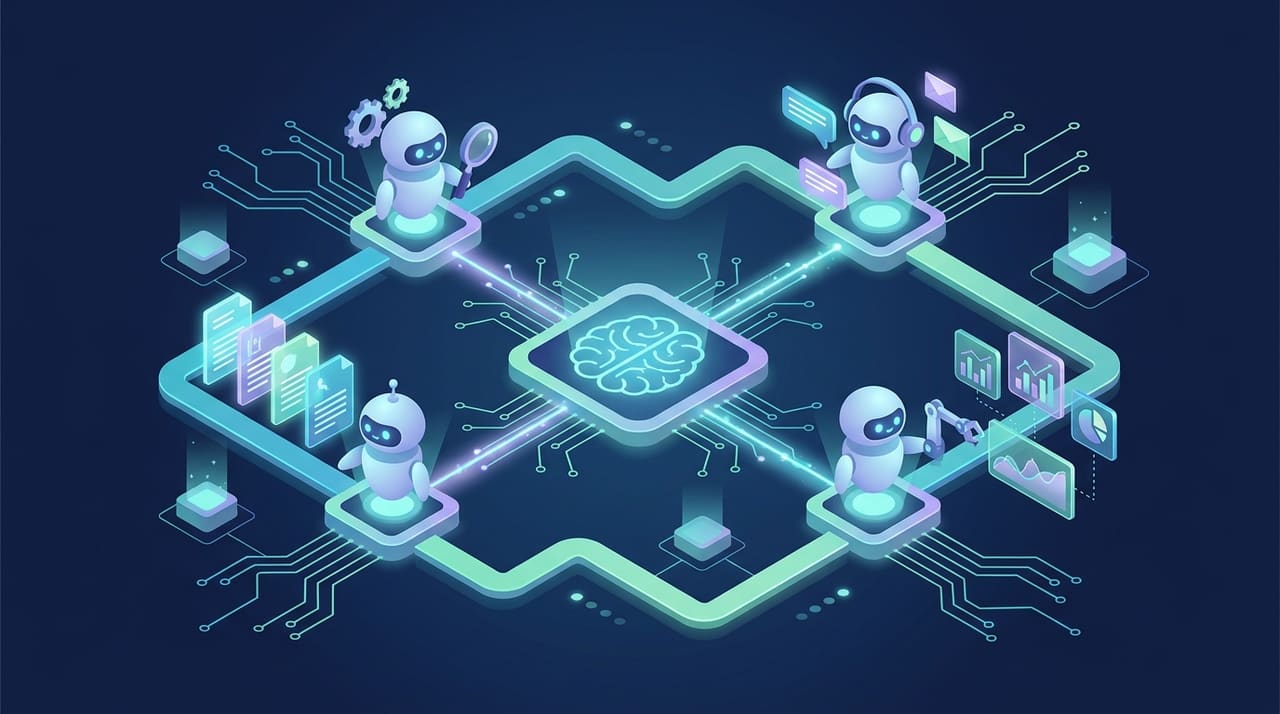
AI agents are software systems that use large language models to pursue goals rather than follow scripts: they interpret an objective, plan the steps, call tools and APIs, check their own results, and keep going until the work is done or a human needs to decide. That loop - reason, act, observe, adjust - is what separates agents from every previous generation of business automation. Chatbots answer; robotic process automation replays; agents work. This article explains what AI agents actually are, how they differ from the automation you already run, where they create measurable value, and how to deploy them without taking risks you cannot see or undo.
What Are AI Agents?
An AI agent combines a language model's reasoning with the ability to act. Where a chat assistant produces a response and stops, an agent treats each response as a step: it can search a knowledge base, query a database, draft an email, call an API, evaluate what came back, and decide what to do next. Autonomy is a dial rather than a switch - the same agent might operate read-only in week one, act with human approval in month one, and handle routine cases end to end once it has earned trust. The definition that matters for business is simple: an agent is automation you brief like a colleague, holding authority the way a colleague would - defined, limited, and auditable.
Agents vs Chatbots vs RPA: What Actually Changed
Businesses have automated for decades; what changed is the kind of work that can be automated. RPA excels at deterministic, repetitive flows but breaks when a screen or file format changes. Rule-based chatbots deflect known questions but collapse outside their decision tree. AI agents handle the messy middle: unstructured inputs, judgment calls within written policy, and multi-step processes that previously needed a person to bridge systems.
| Capability | Traditional RPA | Rule-Based Chatbot | AI Agent |
|---|---|---|---|
| Input it handles | Structured forms and fixed screens | Anticipated phrasings mapped to intents | Unstructured text, documents, and data |
| Response to change | Breaks; scripts must be rebuilt | Fails on anything unlisted | Adapts within defined guardrails |
| Task shape | Repetitive and identical each run | Single-turn answers or fixed flows | Multi-step goals requiring decisions |
| Integration style | Mimics clicks in user interfaces | Canned responses and handoffs | Calls APIs and tools directly |
| Oversight model | Exception queues | Escalation to live chat | Approval gates, logs, and evaluations |
The columns are complements, not competitors: plenty of production systems wrap an agent around existing RPA flows and let it decide which one to trigger, with what parameters, and when to escalate instead.
The Anatomy of an AI Agent
The Reasoning Core
At the center sits a language model guided by a system prompt that encodes its role, policies, and tone. Model choice is a cost-capability trade-off, and mature deployments route simple steps to smaller, cheaper models while reserving stronger ones for genuinely hard reasoning.
Tools and Function Calling
Tools turn text into action: a defined set of functions the agent may call, such as searching the product database, creating a ticket, or issuing a refund below a set threshold. Tool design is where safety lives - an agent can only do what its tools permit, which is why narrow, well-described tools beat broad administrative access every time.
Memory and Knowledge
Agents need context beyond a single exchange: conversation state for the task at hand, retrieval-augmented generation (RAG) over your documents for grounded answers, and longer-term stores for preferences and history. Grounding outputs in retrieved company data is the single most effective countermeasure against hallucinated answers.
Orchestration and Evaluation
Around the loop sits the machinery that makes agents production-grade: step limits, retries, structured logging of every action, evaluation suites that score behavior on realistic scenarios, and escalation paths to humans. This layer, more than the model itself, decides whether an agent is a demo or a dependable system.
Where Agents Deliver Value First
The best first candidates share a profile: high volume, well-documented policy, digital systems of record, and tolerance for review before actions become final.
- Customer operations: triaging inboxes, drafting replies grounded in help-center content, resolving routine requests end to end, and escalating edge cases with a clean summary attached.
- Finance and back office: matching invoices to purchase orders, chasing missing documents, preparing reconciliation drafts, and flagging anomalies for human review.
- Sales and marketing operations: enriching leads, keeping CRM records consistent, drafting personalized outreach for approval, and assembling recurring reports.
- Software delivery: triaging bug reports, drafting tests and documentation, and watching pipelines - work agents handle well under engineering review.
- Research and knowledge work: compiling briefs from internal documents and cited sources in a fraction of the usual time.
Single-Agent vs Multi-Agent Architectures
Start with one agent and a good toolbox. A single capable agent with well-designed tools outperforms a fragile committee of specialized ones, and it is dramatically easier to debug, evaluate, and secure. Multi-agent designs earn their complexity only in specific situations: when roles need different permissions, such as a researcher that reads and an executor that writes; when work parallelizes cleanly across independent subtasks; or when specialized prompts measurably outperform one generalist. If you do go multi-agent, keep an orchestrator that owns the overall plan, and treat each agent's scope as a security boundary - because that is exactly what it is.
Connecting Agents to Your Business Systems
An agent is only as useful as what it can reach. The integration work - clean APIs over your systems of record, retrieval pipelines over your documents, and identity mapping so the agent acts as a scoped service account rather than a superuser - typically outweighs the prompt engineering. Data readiness matters just as much: an agent grounded in outdated or contradictory documentation will confidently produce outdated, contradictory work. Budget for tool building, sandbox environments where actions can be rehearsed safely, and audit trails from day one. This is classic software development discipline applied to a new kind of component, and the teams that treat it that way are the ones whose agents survive contact with production.
Guardrails, Risk, and Human-in-the-Loop Design
Agents introduce real risks - hallucinated facts, prompt injection through content they read, over-broad permissions, and runaway costs - and every one of them has an engineering answer.
- Constrain capability: narrow tools, least-privilege credentials, spending and rate limits, and hard step caps per task.
- Gate irreversibility: anything that sends, deletes, pays, or publishes requires human approval until evidence justifies autonomy - starting with the lowest-stakes actions.
- Ground and verify: retrieval over trusted sources, citations in outputs, and automated checks on high-risk claims.
- Log and evaluate: every action recorded, behavior scored against test suites before each change ships, and drift monitored in production.
- Plan for failure: undo paths, kill switches, and clear ownership for the day the agent gets something wrong.
One principle underlies all of it: treat everything the agent reads as untrusted input. Instructions hidden inside an email, a document, or a webpage must never become the agent's orders.
A Pragmatic Roadmap to Your First Agent
Successful agent programs start deliberately small. Pick one workflow that is frequent, measurable, bounded by written policy, and annoying enough that the team genuinely wants it gone. Define success before building: time saved, resolution rate, and error rate against the current human baseline. Ship a thin pilot with read-only or approval-gated actions, run it beside the existing process, and evaluate honestly on real cases rather than demos. Costs scale with usage volume, model choice, integration complexity, and the level of oversight required - qualitative drivers worth mapping before you commit, since running costs continue as long as the agent works. Expand scope only after the pilot earns trust with data. Structured engagements like this are the heart of practical AI services: less moonshot, more compounding operational wins.
Frequently Asked Questions
Do AI agents replace employees?
In practice they reshape roles rather than erase them. Agents absorb the repetitive, high-volume slice of a job, while people keep the judgment calls, exceptions, and relationships - and gain the time to handle more of them. The organizations seeing the best results redeploy capacity rather than simply cutting it.
How much does it cost to build an AI agent?
It depends on scope far more than on the model. The main drivers are integration complexity, data readiness, the level of human oversight required, and usage volume once live, since model costs scale with activity. Well-run pilots are deliberately small precisely to establish real numbers before any larger commitment.
Are AI agents safe to use with sensitive data?
They can be, with the same discipline you would apply to any system: scoped least-privilege access, redaction where possible, audit logging, and providers whose enterprise terms meet your confidentiality and compliance requirements. The risk lives in casual deployments that skip those controls, not in the technology itself.
Which tasks should not be delegated to an agent?
Anything irreversible or high-stakes without human approval - payments above thresholds, legal commitments, safety-critical decisions - as well as rare, one-off tasks where setup effort exceeds the payoff. The honest test: would you delegate it to a capable new hire on their first week without review?
Do we need to fine-tune our own model?
Rarely. Retrieval over your own data, careful prompting, and well-designed tools cover the overwhelming majority of business cases. Fine-tuning earns its cost only for specialized tone or domain behavior, and only after evaluations prove the simpler approach falls short.
Conclusion
AI agents are the first automation technology suited to the unstructured, judgment-shaped work that sits between your systems - and the first whose failure modes demand engineering discipline as much as enthusiasm. Start narrow, ground everything in your own data, gate what matters, measure against a human baseline, and scale only what proves itself. That path is open to businesses of any size, not just tech giants. If you are weighing where an agent could pay off first in your operations, the team at DIREKTDOTCOM is happy to think it through with you - just get in touch.