API Security Best Practices: Protecting Your Endpoints
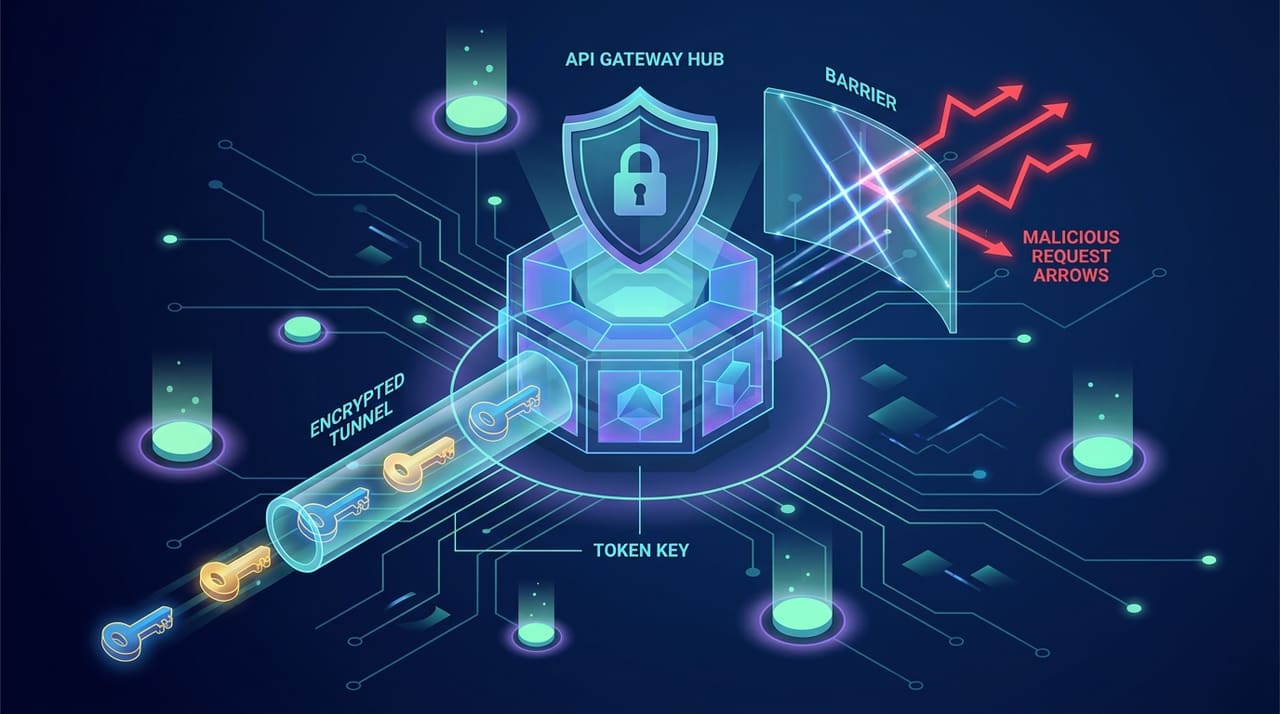
Every modern digital product runs on APIs, which makes API security one of the highest-stakes disciplines in software engineering today. APIs expose your business logic and data directly over the network - to mobile apps, single-page frontends, partners, and increasingly to AI-driven clients. Each endpoint is both a contract and a potential entry point: when an API is compromised, attackers do not need to break into your servers; they simply ask your own interfaces for data, politely and at machine speed. This guide covers the practices that consistently separate resilient APIs from breach headlines: layered authentication and authorization, rate limiting, rigorous input validation, encryption, observability, and security testing woven into the development lifecycle.
Why API Security Matters More Than Ever
APIs concentrate risk in a way traditional web applications never did. A single forgotten endpoint can expose an entire customer table, and automated scanners find unprotected routes within hours of deployment. Several trends keep widening the attack surface: microservices multiply the number of internal interfaces, mobile and IoT clients push APIs onto the public internet, and third-party integrations extend trust beyond your own infrastructure. As more organizations adopt an API-first architecture, the API layer becomes the primary doorway to the business - and attackers have noticed.
APIs are attractive targets for very practical reasons:
- Structured data: JSON responses are self-describing and effortless to harvest at scale.
- Exposed logic: endpoints reveal how your business works, inviting abuse of workflows rather than exploitation of code.
- Automation-friendly: everything about an API is scriptable - including the attack against it.
- Shadow and zombie APIs: undocumented or deprecated endpoints often remain online, unpatched and unmonitored.
Common API Vulnerabilities You Must Understand
The OWASP API Security Top 10 is the reference taxonomy for API risk, and its leading entries have remained stubbornly consistent across editions. Understanding them is the fastest way to focus your defenses where real-world breaches actually happen.
- Broken Object Level Authorization (BOLA): a caller changes an ID in a URL or payload and receives another user's data because the server never verified ownership. This remains the most common and damaging API flaw.
- Broken authentication: weak token validation, missing expiry checks, or credentials accepted over insecure channels.
- Broken object property level authorization: endpoints return more fields than the client needs, or accept fields the caller should never be allowed to set (mass assignment).
- Unrestricted resource consumption: no limits on request rates, payload sizes, or expensive operations, enabling denial of service and runaway infrastructure costs.
- Server-side request forgery (SSRF): user-supplied URLs cause your server to make internal requests an outside attacker could never make directly.
- Security misconfiguration: verbose error messages, permissive CORS policies, and debug endpoints left enabled in production.
Authentication: Verifying Every Caller
Authentication answers one question: who is calling? Every endpoint - including internal ones - should require it, and the mechanism should match the sensitivity of the data behind it. Anonymous access should be a deliberate, documented exception, never a default.
Choosing an Authentication Model
| Method | Best Suited For | Strengths | Trade-offs |
|---|---|---|---|
| API keys | Server-to-server calls and low-sensitivity integrations | Simple to issue, meter, and rotate | No user identity or scopes; easily leaked if embedded in client code |
| OAuth 2.0 with OpenID Connect | User-facing apps and delegated third-party access | Standardized flows, scoped consent, mature libraries | More moving parts; misconfigured flows create serious gaps |
| JWT access tokens | Stateless microservices and distributed systems | Self-contained claims, fast local validation | Revocation is hard; signature and expiry must be strictly verified |
| Mutual TLS (mTLS) | Service-to-service traffic and high-security B2B links | Strong cryptographic identity for both parties | Certificate lifecycle management adds operational overhead |
In practice, mature platforms combine models: OAuth 2.0 with short-lived JWT access tokens for user traffic, and mTLS or signed service tokens between internal services.
Token Hygiene
- Keep access tokens short-lived and refresh them server-side; long-lived tokens are breach multipliers.
- Validate signature, issuer, audience, expiry, and algorithm on every request - never accept unsigned tokens.
- Never pass tokens in URLs, where they leak through logs, referrer headers, and browser history.
- Support immediate revocation for compromised credentials and rotate signing keys on a schedule.
Authorization: The Layer Attackers Test First
Authorization answers the harder question: what is this caller allowed to do? Many high-profile API breaches were authorization failures rather than authentication failures - the attacker logged in legitimately, then accessed objects that were never theirs. Enforce authorization on every request, at the object level, on the server. The client must never be trusted to filter data or hide functionality as a security measure.
Adopt deny-by-default policies, model permissions explicitly - role-based access control for simple domains, attribute-based rules where context matters - and centralize decisions in middleware or a policy engine instead of scattering checks across handlers. Every query that fetches a resource by ID should also assert the caller's right to that specific resource. Your automated tests should attempt cross-tenant access with valid credentials; if those tests pass silently, you have found a future incident before an attacker did.
Rate Limiting and Abuse Prevention
Rate limiting protects availability, blunts brute-force attempts, and caps the blast radius of leaked credentials. Apply limits per API key, per user, and per IP, with stricter thresholds on sensitive operations such as login, password reset, and data export. Algorithms like token bucket or sliding window smooth out bursts without punishing legitimate spikes, and returning HTTP 429 with a Retry-After header lets well-behaved clients back off gracefully.
Pair limits with quotas per plan or partner, payload size caps, timeouts on expensive queries, and bot detection on endpoints that attract credential stuffing. The goal is graduated friction: honest traffic barely notices, while abusive patterns hit walls quickly and visibly in your monitoring.
Input Validation and Injection Defense
Every byte that crosses your API boundary is untrusted. Validate requests against a strict schema - OpenAPI or JSON Schema definitions make this enforceable at the gateway or middleware layer - and prefer allowlists that define what is acceptable over blocklists that try to guess what is dangerous. Reject unknown fields to prevent mass assignment, cap array lengths and string sizes, and enforce content types on every route.
Injection remains a threat wherever input reaches an interpreter: SQL, NoSQL, OS commands, or template engines. Parameterized queries and vetted ORMs eliminate most SQL injection risk; never build queries through string concatenation. Encode output for its destination context, sanitize file uploads by type, size, and storage location, and keep error responses generic - a stack trace in a response body is a reconnaissance gift.
Encryption and Secrets Management
Encrypt everything in transit with TLS 1.2 or newer, enforce HTTPS on every route, and enable HSTS so clients never silently downgrade. Encrypt sensitive data at rest, and consider field-level encryption for high-value attributes such as identity documents or payment references. Encryption only works when keys are managed well: store secrets in a dedicated vault rather than in code, container images, or environment files committed to repositories.
- Rotate credentials and signing keys on a defined schedule - and immediately after any suspected exposure.
- Prefer short-lived, dynamically issued credentials for services over static passwords.
- Scan repositories and build pipelines continuously for leaked secrets.
- Log secret access so you can answer who read what, and when, during an investigation.
Gateways, WAFs, and Defense in Depth
An API gateway gives you a single enforcement point for authentication, rate limiting, schema validation, and routing - dramatically reducing the chance that one service forgets a control. A web application firewall filters known attack patterns before they reach your code. Neither replaces secure implementation; they are outer layers in a defense-in-depth strategy that assumes any single control can fail.
Inside the perimeter, apply zero-trust principles: services authenticate to each other, network policies segment workloads, and internal APIs receive the same scrutiny as public ones. Many breaches begin at a public edge but succeed because the network behind it was flat and trusting.
Monitoring, Testing, and the Secure Development Lifecycle
You cannot defend what you cannot see. Emit structured logs for authentication events, authorization denials, rate-limit hits, and error spikes - without ever writing tokens or personal data into the logs themselves. Baseline normal traffic per endpoint and alert on anomalies such as sequential ID enumeration or sudden geographic shifts. Maintain an incident runbook so the first hour of a breach is procedure, not improvisation.
Shift security left as well: static analysis and dependency scanning in CI, schema linting for new endpoints, and security-focused code review for anything that touches authorization. Complement automation with periodic penetration testing by people who think like attackers. Organizations without deep in-house expertise often engage specialized cybersecurity services for audits, hardening, and continuous monitoring rather than building that capability from scratch.
Frequently Asked Questions
What is the OWASP API Security Top 10?
It is a community-maintained ranking of the most critical API security risks, published by the OWASP Foundation and updated as attack patterns evolve. Treat it as a design and testing checklist: if your team can explain how each risk is mitigated in your stack, you are ahead of most of the industry.
Are API keys enough to secure an API?
Only for low-sensitivity, server-to-server scenarios. API keys identify a calling application, not a user, and carry no scopes or expiry by default. For anything involving user data, combine OAuth 2.0 or JWT-based authentication with TLS, rate limiting, and regular key rotation.
How is API security different from general web application security?
The foundations overlap, but APIs expose object access and business logic directly, so object-level authorization, schema validation, and machine-speed abuse become the dominant concerns. There is also no user interface to obscure anything: whatever the API returns, the attacker sees.
How often should we test our API security?
Continuously and periodically. Automated scanning, dependency checks, and authorization tests should run in every build, while manual penetration tests make sense at least annually and after major architectural changes such as a new authentication flow or public API launch.
Do internal APIs need the same level of protection?
Yes. Zero-trust thinking exists because attackers routinely land on low-value systems and move laterally. One compromised laptop or dependency makes the word internal meaningless, so internal endpoints need authentication, authorization, and logging just like public ones.
Conclusion
API security is not a product you install once; it is a set of habits enforced by architecture: authenticate every caller, authorize every object access, validate every input, encrypt every connection, limit every resource, and watch everything. Teams that build these habits ship faster, not slower, because they spend far less time firefighting. At DIREKTDOTCOM, security review is a standard part of how we design and build APIs for our clients - if you would like an experienced set of eyes on your endpoints, feel free to get in touch.