Website Lead Generation: Turning Traffic into Enquiries
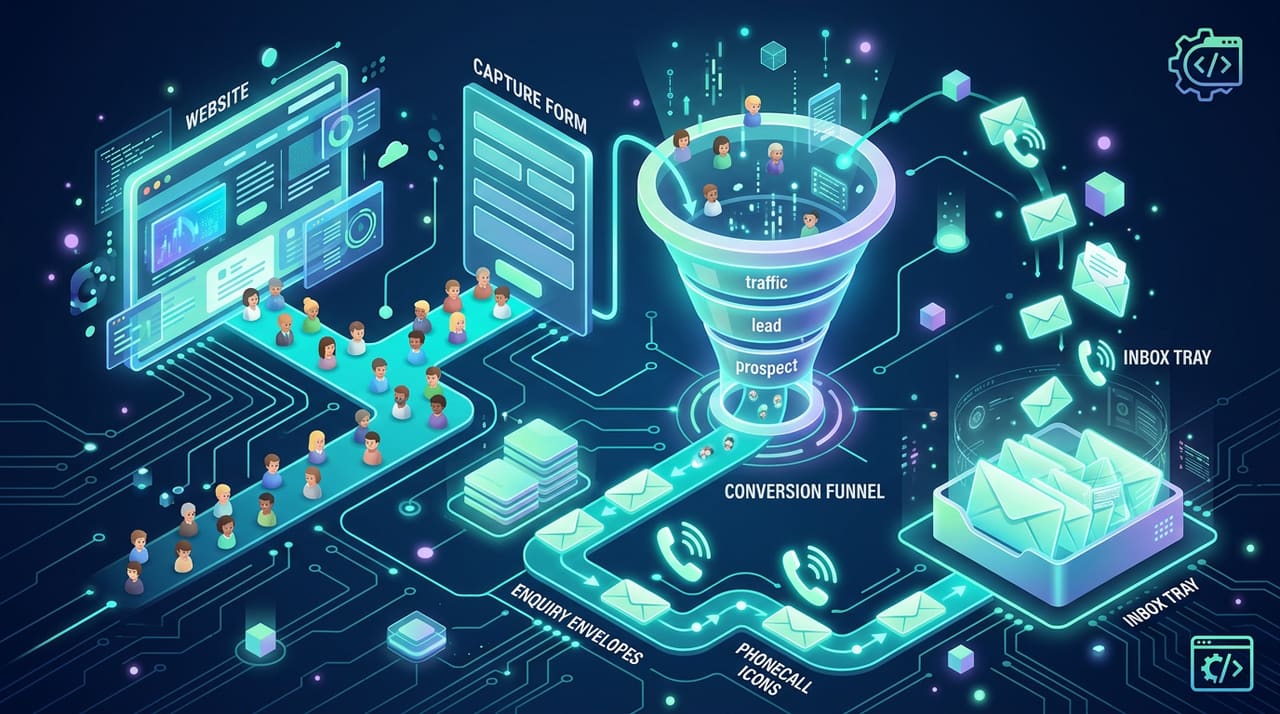
A business site that merely describes the business is a brochure; a site that produces a steady flow of enquiries is an asset. Website lead generation is the discipline of turning anonymous visitors into named prospects, people who have raised a hand by filling a form, starting a chat, requesting a call or downloading something useful. It is not one tactic but a system: attracting the right traffic, offering a reason to make contact, removing friction from the act itself, earning trust along the way and following up fast enough to matter. This guide walks through that system end to end, so you can find where your own site leaks and fix it deliberately.
What Website Lead Generation Really Means
A lead is a person who has identified themselves and shown intent, which makes lead generation fundamentally an exchange: the visitor gives contact details and permission, and receives something worth that price, an answer, a quote, a consultation, a genuinely useful resource. Framing it as an exchange changes the design questions. Instead of "how do we capture more emails", you ask "what would make contacting us the obviously sensible next step for someone with this problem". It also sets the quality bar: a thousand curious downloaders can be worth less than twenty visitors asking for a quote, so the goal is not maximum names but maximum qualified conversations. Every element discussed below, offers, forms, trust, follow-up, serves that exchange, and a professional website is simply the machine that performs it around the clock.
Map the Journey from First Visit to Enquiry
Visitors arrive with different levels of readiness, and a site that only says "contact us" serves just the tiny fraction who are ready today. Sketch the journey your buyers actually take: a problem-aware visitor reads an article, a solution-aware visitor compares approaches on a service page, a decision-stage visitor checks credentials and pricing signals, and only then does an enquiry happen. Each stage needs its own next step, a relevant deeper page, a useful resource, a low-commitment question channel, so that momentum is never dropped. Audit your analytics for the paths that end in enquiries and, just as important, the high-traffic pages where journeys silently die. Most sites discover a handful of pages carrying nearly all the intent, with no tailored path onward, which is the cheapest fix in the whole discipline.
Offer Something Worth a Form Fill
Nobody wakes up wanting to fill in a form; they want what is on the other side. The strength of that offer moves results more than any cosmetic optimization, and different offers suit different readiness stages:
- Direct-response offers for ready buyers: a quote, an audit, a consultation, a demo, with a clear promise of what happens next and how quickly.
- Educational lead magnets for researchers: a practical guide, a checklist, a template or a calculator that solves a piece of the problem now.
- Low-commitment channels for the hesitant: a chat window, a WhatsApp button or a callback request that starts a conversation without ceremony.
- A newsletter for the not-yet-ready, kept honest by actually being worth reading.
Whatever you offer, deliver it instantly and make it genuinely good; a thin, salesy PDF converts once and burns the trust that future offers would have needed.
Forms and CTAs: Where Friction Goes to Hide
The mechanics of asking are where intent most often dies. Calls to action should be specific, visible and honest about what follows: "Request a quote, we reply within one business day" outperforms an ambiguous "Learn more" because it sets a concrete expectation. Place CTAs where decisions happen, after benefits, after proof, at the end of articles, not only in the header. Forms should ask the minimum your first response genuinely needs, usually a name, one contact channel and a sentence about the need; every additional field must justify itself with real downstream value. Label fields clearly, validate inline, make error messages human, and confirm submission with a page that says what happens next rather than a bare "thank you". On mobile, where much of your traffic lives, check that the entire act, find the CTA, complete the form, send, can be done comfortably with one thumb in under a minute.
Choosing Capture Channels: Not Every Lead Wants a Form
Different audiences and moments favor different channels, and offering two or three well-chosen ones captures intent a single form would miss:
| Channel | Visitor intent | Effort for visitor | Best suited to |
|---|---|---|---|
| Quote or contact form | High, ready to engage | Medium | Detailed service enquiries |
| Live chat or WhatsApp | Medium, has questions | Low | Quick answers that warm into enquiries |
| Phone or callback request | High, urgency or complexity | Low | Local services, urgent needs |
| Downloadable guide | Low to medium, researching | Low | Early-stage education and nurture |
| Newsletter signup | Low, staying informed | Very low | Long sales cycles, repeat audiences |
Resist the temptation to bolt on every channel at once; each must be staffed and answered well, and an ignored chat widget generates anti-leads, visitors who tried you and got silence.
Attract the Right Traffic in the First Place
Lead generation starts before anyone reaches the site, because conversion rates are downstream of traffic quality. Content aimed at the questions your buyers actually ask, comparison articles, cost explainers, how-to guides, process breakdowns, draws visitors with the problem you solve, and search engines reward the depth. Service pages should target the commercial phrases people use when ready to hire, one clear page per service rather than a single vague catch-all. Paid campaigns can buy immediate intent while organic assets mature, provided each ad lands on a page that continues its promise. The disciplines reinforce each other: strong content earns rankings and retargeting audiences, while well-run digital marketing feeds data back about which messages and audiences produce enquiries rather than mere clicks. Judge every channel by leads produced, not traffic delivered.
Trust: The Silent Conversion Factor
Before contacting you, a visitor performs a quiet risk assessment, and the site answers it whether you designed the answer or not. Show the evidence you can honestly show: named reviews given willingly, recognizable client logos used with permission, certifications, professional affiliations, real team photos and a physical address. Make expertise visible through the substance of your content rather than adjectives about yourself; a genuinely useful article is proof, "we are passionate about excellence" is noise. Sweat the hygiene factors, since visitors certainly do: a current copyright year, working links, HTTPS, a privacy policy that plainly explains what happens to submitted data, and consent handling that respects the law. Never fabricate testimonials or invent client stories; one detected fake retroactively poisons every true claim on the site, and detection is more common than fabricators assume.
Follow-Up: Where Most Leads Are Actually Lost
The least glamorous stage decides the most revenue. An enquiry is a perishable thing: the visitor is comparing options now, and the firm that responds first, competently, holds an advantage no landing page can replicate. Set an internal service level for first response and measure it honestly, including evenings and weekends if your buyers enquire then. Automate the safety net, an immediate acknowledgment that confirms receipt and sets expectations, routing that puts the lead in front of the right person, and a CRM record created without manual copying, so nothing depends on somebody noticing an inbox. For leads not ready to buy, a short, genuinely helpful email sequence keeps the relationship warm without pestering. And close the loop commercially: track which leads became customers, and which sources produced them, because that is the number the whole system exists to move.
Measure What Matters
Traffic is a vanity metric until it is qualified by outcomes. Instrument the funnel end to end: sessions by source, conversion rate per page and per channel, cost per lead where you pay for traffic, lead-to-customer rate and, where possible, revenue per source. Segment before concluding, since a blended conversion rate hides the truth that some pages and sources convert superbly while others merely spend. Watch quality signals as closely as volume: a change that doubles leads but fills the pipeline with mismatched enquiries has made the business worse while flattering the dashboard. Review monthly, pick the single weakest stage, attract, convert, trust, follow up, and improve that stage deliberately before touching anything else. Lead generation compounds precisely because the stages multiply together: a modest gain at each stage multiplies into a transformed pipeline.
Frequently Asked Questions
What is website lead generation?
It is the process of converting anonymous website visitors into identified prospects, through forms, chats, calls, downloads or signups, by combining the right traffic, a compelling reason to make contact, low-friction capture, visible trust and prompt follow-up into one measured system.
How can I get more leads without more traffic?
Improve the exchange: strengthen the offer, cut form fields to the minimum, add a low-commitment channel such as WhatsApp or callback, place CTAs where intent peaks, and surface honest proof near them. Most sites can grow enquiries substantially from existing traffic before buying more.
Do lead magnets still work?
Yes, when they solve a real slice of the visitor's problem, a practical checklist, template or calculator, and are delivered instantly. Thin, promotional PDFs no longer earn contact details. Match the magnet to the buying stage and follow up with substance, not pressure.
How fast should we respond to an enquiry?
As fast as you can institutionalize, ideally within business hours of receipt and never later than one business day. Enquirers are usually comparing several providers at once, and the first competent response frames the conversation. Automated acknowledgment buys time but never replaces the human reply.
Which metric matters most?
Qualified leads per month and their conversion to customers, tracked by source. Traffic and raw form fills are inputs, not outcomes. If you can only watch two numbers, watch cost per qualified lead and lead-to-customer rate; together they tell you whether the system earns its keep.
Conclusion
Website lead generation is a chain, traffic, offer, capture, trust, follow-up, and the chain yields to whoever strengthens its weakest link first. Audit your site honestly against each stage, fix the leak that costs most, and let measurement, not fashion, choose the next improvement. Built patiently, the system becomes the most reliable salesperson the business owns, working every hour without being asked. At DIREKTDOTCOM we build sites and campaigns with this chain in mind from the first wireframe, and if you would like a candid look at where your site is losing enquiries, get in touch, we are happy to share what we see.